


If you’re a SaaS founder or CTO looking to hire software developers in Europe, you already know the pitch: strong engineers, timezone overlap, lower cost than hiring locally in Germany or the UK. What most guides won’t tell you is that Europe is not one market.
Rates vary by 3x within the same region, talent pools skew heavily toward certain stacks, and the timezone advantage people talk about is real for your morning standups but disappears entirely if you’re US West Coast.
This guide covers the seven countries where HighCircl sources senior engineers, based on our Q1 2026 candidate pool. We vet and place senior engineers exclusively - all rates and data here reflect that tier only.
The ranking doesn’t pick a winner, because the right answer depends on your stack, your budget, and where your team sits. What it does is give you the variables that matter so you can make that call yourself.
Country overview
HighCircl sources senior engineers only. All rates reflect senior profiles. Specialized engineers (AI, fintech, health-tech) can command a 10-20% premium on top of these figures.
| Country | Senior rate (€/hr) | EU member | Timezone | Pool size |
|---|---|---|---|---|
| Poland | €55-75 | Yes | CET | Very large (300k+ IT pros) |
| Romania | €40-65 | Yes | EET | Large (250k+ IT pros) |
| Serbia | €35-55 | No | CET | Medium |
| Hungary | €40-65 | Yes | CET | Medium |
| Slovakia | €40-65 | Yes | CET | Small |
| Slovenia | €40-65 | Yes | CET | Small |
| Spain | €45-85 | Yes | CET | Large |
How we compare countries for hiring software developers in Europe
Three dimensions drive every country comparison in this guide.
Cost means staff augmentation rates for senior engineers, drawn from HighCircl placements and our senior developer cost guide. Rates within a country vary more than most guides admit. A senior React engineer in Warsaw and a senior React engineer in a smaller Polish city are not the same price.
Timezone is evaluated against CET business hours (09:00-18:00). 80% of HighCircl’s talent pool operates on CET. For Western European founders, that’s near-total overlap. For US East Coast teams, you get a reliable 3-hour morning window. Based on what we see from our clients, that’s enough for a daily standup and async collaboration to carry the rest. US West Coast is harder: a 9-hour gap makes synchronous work difficult without someone working unusual hours.
Quality signals covers English proficiency, STEM pipeline, and what stacks we actually see in senior candidates coming through our vetting process.
Poland: The largest talent pool in central Europe
Poland has the most mature tech ecosystem of the seven countries here. Warsaw, Kraków, and Wrocław host R&D offices for Google, Intel, and Siemens, which means the senior developer market is deep but increasingly competitive on price. Rates for senior engineers via staff augmentation in Poland run €55-75/hr, putting it at the higher end of the CEE range.
For SaaS teams hiring in Poland, the main advantage is pool size. If you need to scale a team rather than place a single engineer, Poland gives you options that smaller markets can’t. HackerRank ranks Polish developers first globally in Java proficiency - but in Q1 2026, the most common profile we see coming through is full-stack, specifically React on the frontend and Node.js on the backend. Java backend expertise is the second most frequent. Pure Java profiles exist but are less dominant than the country’s reputation suggests.
English proficiency is high. Business communication is generally smooth without needing to account for language friction.
Good fit for: Teams that need volume, or that need to place multiple engineers across different seniority levels quickly.
Romania: Best cost-to-quality ratio in the EU
Romania consistently shows up in any honest comparison of European developer markets. Rates for senior engineers sit at €40-65/hr via staff augmentation - meaningfully lower than Poland, with comparable technical quality for most SaaS-relevant stacks. The country has over 250,000 IT professionals, with Bucharest and Cluj-Napoca as the main hubs. Companies like Stripe, IBM, and Oracle all have engineering teams there.
Stack-wise, Romania mirrors the broader trend we see across our pool: full-stack React/Node.js profiles dominate, with Java backend as a clear second. The country has a reputation in fintech and backend-heavy work, which holds up in practice.
Romania is an EU member, GDPR-compliant, and operates on EET (UTC+2), giving it one hour ahead of CET. For most Western European clients that’s irrelevant. For US East Coast teams, it’s a slightly shorter overlap window but still workable.
The one honest caveat: brain drain is a real issue in Romania. Senior engineers with strong English and in-demand skills have options across the EU. Retention matters more here than in markets with a less mobile workforce.
Good fit for: Founders who need senior engineers at CEE rates without the risk premium that comes with non-EU markets.
Serbia: Competitive rates, outside the EU
Serbia sits outside the EU, which some companies treat as a dealbreaker and others don’t think about at all. For a Western European SaaS company hiring via staff augmentation, EU membership rarely matters operationally. Your contracts are with a staffing partner, not the developer’s government. For companies that need EU data residency guarantees, it’s worth flagging.
Rates are lower than Romania: senior engineers typically run €35-55/hr. Belgrade has grown into a genuine tech hub over the past five years, with Microsoft and Amazon both operating locally. The talent pool is smaller than Poland or Romania, but quality at the senior level is solid.
Timezone is CET. Full overlap with Western Europe, same 3-hour US East Coast window as the rest.
Good fit for: Teams comfortable with non-EU contracts that want the lowest rates in the pool without going outside Europe.
Hungary and Slovakia: Underrated mid-tier options
Neither country appears in most rankings, which is partly why rates have stayed reasonable. Hungary and Slovakia both produce strong engineers, operate on CET, and have tech communities more concentrated than their population sizes suggest.
Slovakia has around 40,000 developers with over 90% English fluency, according to Clutch data. Budapest has a growing startup scene and a pipeline of university graduates feeding into software development. Rates for senior engineers in both countries are broadly in line with Romania — €40-65/hr — though the pool is smaller and sourcing takes longer.
For founders who’ve been burned by the “senior developer from Poland” pitch that turned out to be mid-level talent at senior rates, these markets sometimes yield better signal-to-noise on actual seniority.
Good fit for: Companies open to less obvious markets, or that have already exhausted the obvious shortlists in Poland and Romania.
Slovenia: Small pool, high quality
Slovenia is a small market (just over two million people total) but it punches above its weight technically. Ljubljana has a concentrated developer community, strong English, and EU membership. It’s CET timezone.
The constraint is volume. If you need one strong senior engineer, Slovenia is worth including in your search. If you need a team of five, you’ll probably need to supplement from elsewhere.
Rates are broadly comparable to Romania and Hungary. The market is less saturated with nearshore hiring demand than Poland, which occasionally means faster time-to-match.
Good fit for: Single senior hire requirements, or companies that want EU membership and haven’t had success in larger markets.
Spain: The Western Europe option with CEE-adjacent rates
Spain doesn’t belong in the same conversation as Romania or Serbia on cost, but it doesn’t belong in the same conversation as Germany either. Rates for senior engineers in Barcelona and Madrid run €55-85/hr via staff augmentation, which overlaps with the upper end of CEE pricing but comes with Western European employment norms, culture, and timezone.
Spain operates on CET (CEST in summer), which means full overlap with Western Europe and is the best option in this list for US West Coast teams. A San Francisco-based company hiring a developer in Barcelona still faces a 9-hour gap, but if you’re running async-first with a late-afternoon US standup, it’s workable in a way that Eastern European markets aren’t.
Stack-wise, Spain skews more frontend-heavy in what we see in our Q1 2026 pool. Strong React profiles, solid Node.js. Python backend is less frequent than in Poland or Romania.
Good fit for: US West Coast companies willing to pay a small premium for the best timezone fit, or Western European teams that want cultural proximity alongside technical capability.
Timezone overlap for European software developers
Most guides say Europe overlaps with US East Coast and leave it there. CET business hours run 09:00-18:00. US East Coast is UTC-5 in winter, UTC-4 in summer. That gives you a 3-hour window in the afternoon (14:00-17:00 CET / 09:00-12:00 ET). Our clients make it work: standup at 15:00 CET, async through the day, end-of-day syncs as needed.
Three hours of overlap is the minimum for effective collaboration. Every country in this guide meets that bar for Western European and US East Coast teams. For Western European founders hiring nearshore software developers in Europe, the timezone question is largely moot. CET-to-CET is full overlap.
Stack availability across European developer markets
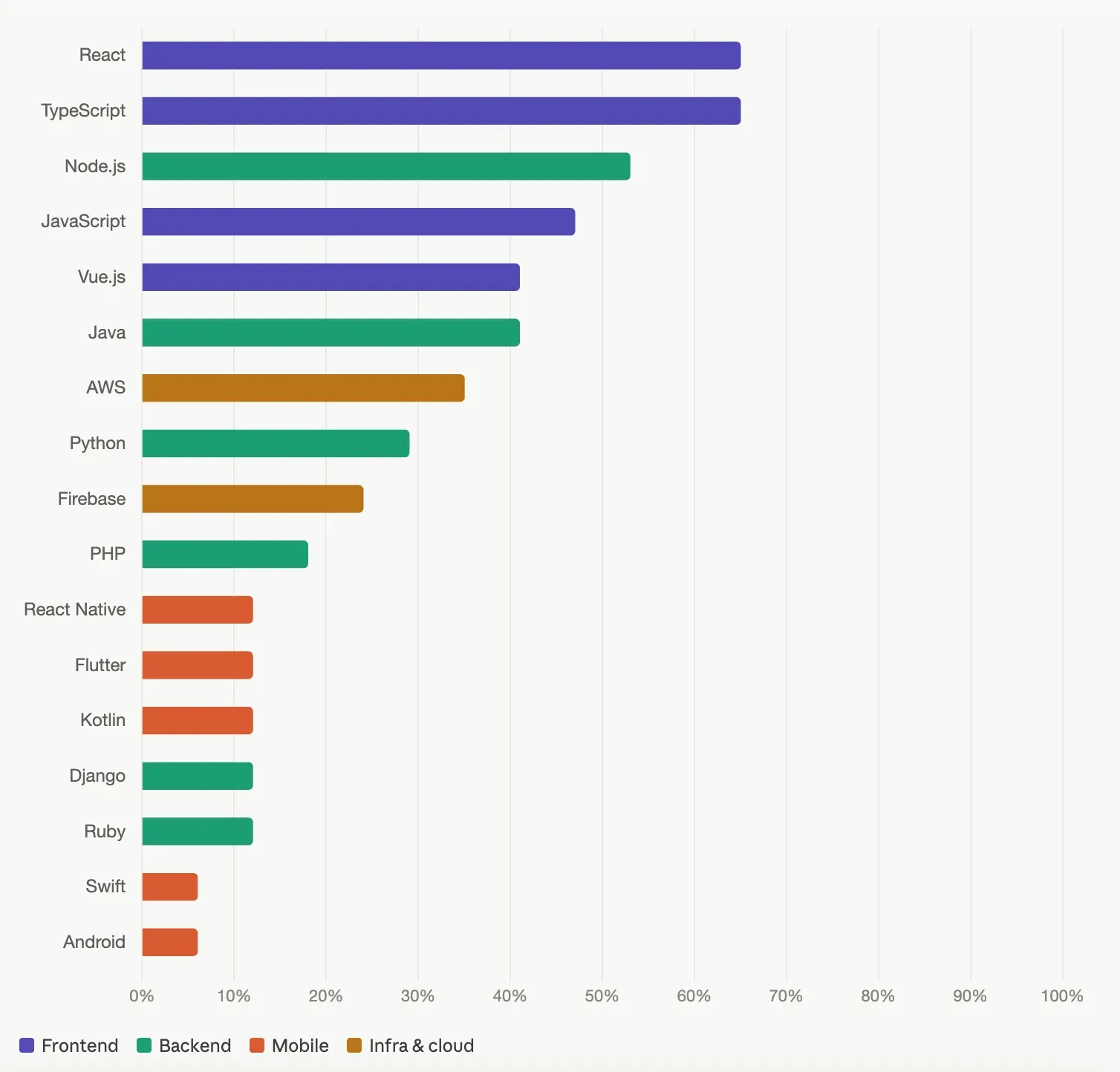
Across all seven countries, full-stack React and Node.js profiles dominate the senior candidate pool in Q1 2026. Poland has the largest absolute volume for both stacks. Romania shows strong backend depth, particularly in fintech profiles. Spain skews more frontend-heavy — React profiles are plentiful, Node.js is solid, but Python backend is less frequent than in Poland or Romania. Hungary, Slovakia, and Slovenia mirror the overall pool trend; their sample sizes are narrower, so stack-level patterns are less reliable.
Python backend is the clear second across the board, but the pool is smaller and you’re competing more for it. AI/ML, DevOps, and cloud infrastructure profiles exist at senior level but command a 20-40% rate premium regardless of country.
Which country should you hire software developers from?
HighCircl vets and places senior engineers exclusively, so the rates in this article reflect that tier only. Mid-level and junior profiles are not something we have data on from our own pool.
The rates are ranges for a reason. A senior Node.js engineer in Warsaw with eight years of product company experience and strong English is not the same hire as a senior Node.js engineer two hours outside Warsaw with eight years of agency work. Both will show up in search results, both will list the same years of experience. The difference shows up in the code review, the architecture discussions, and how they behave when a sprint goes sideways.
Rate ranges also shift by stack. Senior engineers in AI/ML, DevOps, and cloud infrastructure command a 20-40% premium on top of the base regional rate, regardless of country. Hiring a senior Python ML engineer in Romania at 40/hr is not realistic in 2026. Hiring a senior React/Node.js full-stack engineer at that rate is closer to achievable.
For a detailed breakdown of what rates look like by hiring model, staff augmentation vs. direct hire vs. platforms like Toptal, see our senior developer cost guide.
HighCircl vets and places senior engineers exclusively, so the rates in this article reflect that tier only. Mid-level and junior profiles are not something we have data on from our own pool.
No single country wins for every company. But here’s how to think about it:
If pool size matters most, hire software developers in Poland. If cost-to-quality within the EU is the priority, Romania. If you want the lowest nearshore rates and non-EU contracts don’t bother you, Serbia. If you’re US West Coast or want Western European culture with reasonable rates, Spain. If you’re placing a single senior hire and the main markets feel oversubscribed, Hungary, Slovakia, or Slovenia are worth a look.
The stack question cuts across all of them. If you’re building on React and Node.js, you’re in the majority of what the European nearshore developer market produces in 2026. Python backend is available but the pool is smaller. If you need something more niche, Rust, Go, or Elixir at senior level, narrow the country question and focus on where that specific community is strongest.
Frequently Asked Questions
Which European country has the lowest software developer rates in 2026?
Serbia. Senior engineers via staff augmentation typically run €35-55/hr, the lowest of any EU-adjacent market without leaving Europe entirely. Romania is the cheapest option within the EU.
Do I need EU-based developers for GDPR compliance?
Not automatically. GDPR applies to how you handle data, not where your developer is located. That said, EU-based developers (Poland, Romania, Hungary, Slovakia, Slovenia, Spain) remove any ambiguity if your legal team or enterprise clients ask the question.
How much timezone overlap do I need for effective collaboration?
Three hours of same-day overlap is the minimum that works in practice. Every country in this guide meets that bar for Western European and US East Coast teams. US West Coast is harder. Spain is your best option there.
What stacks are most available in European nearshore markets right now?
In Q1 2026, full-stack React and Node.js profiles dominate. Python backend is a clear second. If you need AI/ML, DevOps, or cloud infrastructure at senior level, budget for a 20-40% rate premium regardless of country.
How long does it take to hire a developer in Europe through staff augmentation?
Through traditional recruitment in the EU, 35-50 days on average, and longer for senior roles once notice periods are factored in. A vetted staff augmentation partner should deliver a shortlist in 72 hours.
Is staff augmentation or direct hire better for European developers?
Depends on the time horizon. Staff augmentation is faster, has no upfront recruitment fee, and lets you scale without long-term commitment. Direct hire makes more sense once you’re certain about the role and have time to run a full search. Many companies start with augmentation and convert later.
Can US companies hire European developers, or is this mainly for European teams?
US companies hire from Europe regularly, particularly from Poland, Romania, and Serbia for US East Coast timezone fit. The main constraint for US West Coast is the 9-hour gap. It’s workable async-first but difficult for synchronous collaboration.